Tibetan buddhist teacher Pema Chodron offers some very useful wisdom about living a spiritual path, and guidance for navigating through rough passages and avoiding pitfalls.
a young Diedre Blomfield Brown
Pema Chodron
Pema Chödrön (born Deirdre Blomfield-Brown on July 14, 1936) is an American Tibetan Buddhist. She is an ordained nun, acharya and disciple of Chögyam Trungpa Rinpoche. Chodron has written several books and is the director of the Gampo Abbey in Nova Scotia, Canada.
Daniel Bachman calls Durham, N.C., home now, but he grew up around the Rappahannock River in Fredericksburg. It’s a quiet town in Northern Virginia that still has a pharmacy with cheap sandwiches and milkshakes; but, as Bachman pointed out to us, it has more tattoo parlors than music stores these days. That’s not a judgment, just the way things are.The 25-year-old has been at the solo-guitar game since he was a teenager, befriending folks like the since-departed Jack Rose and slowly finding his own way into the music. That’s why it felt right to bring Bachman back to the area that inspired River, a record surrounded by history, but guided by hands and a heart that know its bends and bumps.In early March, we met Bachman in Fredericksburg to drive an hour east to Stratford Hall, home to four generations of the Lee family, which includes two signers of the Declaration of Independence; it’s also the birthplace of Robert E. Lee. Bachman knows it well, not only because his dad works there, but also because he can’t help but bury himself in history books about the region.There’s still snow on the ground when we arrive, as we scrape chunks of mud from our boots before entering the impeccably preserved Great House. Overlooking the rolling hills of Virginia, Bachman plays a version of “Song For The Setting Sun II” in what was the performance space at Stratford Hall. The song leaps boldly around the sunlit, symmetrical room, bouncing off walls decorated with paintings of buxom women and men in powdered wigs. -npr clip notes
Some spend a lifetime developing an understanding of the Tao, and in the light of that, a four and a half minute synopsis of Lao Tzu and his teachings seems comically philistine. But as with most School of Life videos, Lao Tzu and his teachings are summed up responsibly and accurately, albeit far from exhaustively. Go School Of Life!
At about 3:30, song ends, and Monk is not happy with producer’s response to his question. Very cool look at the inner workings of a jazz legend.
Thelonious Monk: Straight No Chaser. Filmmaker Bruce Ricker couldn’t believe his luck. Michael and Christian Blackwood’s extensive 1968 footage of the groundbreaking modern jazz pianist and composer Thelonious Monk, including the only footage of the very private Monk off stage, was in excellent condition. The reels were, in Ricker’s words, “just sitting there like the Dead Sea Scrolls of jazz.” Ricker, as co-producer, joins director and fellow producer Charlotte Zwerin (Gimme Shelter), executive producer Clint Eastwood and others to bring these scrolls to astonishing life. Their Thelonious Monk: Straight No Chaser combines the Blackwood’s rare footage of Monk in studio on tour and behind the scenes with new interviews, archival photos and more to create a landmark aural and visual treat. Year: 1988 Director: Charlotte Zwerin
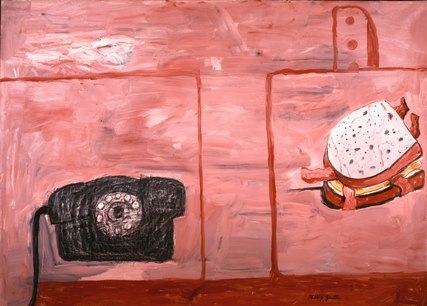
Late in life, the artist looks back over a career that originated in social realism during the ’30s, moved to the center of Abstract Expressionism, and culminated in a return to figuration. Filmed at his retrospective in San Francisco in 1980 and at his Woodstock studio, where Guston is seen painting, the artist speaks candidly about his philosophy of painting and the psychological motivation for his work.
Initial release: 1982
Director: Michael Blackwood
Producer: Michael Blackwood
Editor: Ned Bastille
Cast: Philip Guston
Cinematography: Christian Blackwood, Mead Hunt
kneeling to the god of eclecticism and allergic to the commonplace


 The Incubator