Videos

La Monte Young & Marian Zazeela :: The Black Album 1969

c8m906mr-fileid-1-53-43

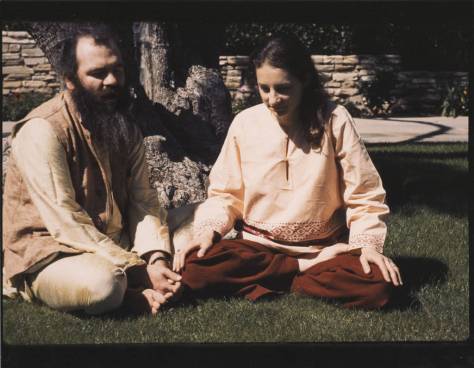
Young & Zazeela recorded their first full length album in Munich for Heiner Friedrich’s Edition X label. Released as a limited edition of 2000, the first 98 were signed & dated by the artists. Side one is a section of “Map of 49’s Dream”, performed by Young with sinewave drone & voice, with vocal accompaniment by Zazeela. Side two is an extract from “Study for the Bowed Disc” featuring the duo bowing a gong given to them by sculptor Robert Morris. Morris had made it for his dance piece “War” & asked Young to play it for the performance. Afterwards Morris presented the gong to Young, who began experimenting on it with double bass bows. Young recommended the listener turn the musick up (PLAY FUCKING LOUD), the resulting low drone being a spiritual tool. For the album artwork, Marian Zazeela embedded her calligraphic lettering & designs in black. The point is to focus on her artwork while concentrating on the vocal/sinewave drones of Young’s dream music. Continue reading La Monte Young & Marian Zazeela :: The Black Album 1969

TWYLA THARP/ DAVID BYRNE :: THE CATHERINE WHEEL, 1981 >an early artworld cross over into mainstream pop culture

The Catherine Wheel was a seventy-two minute dance film choreographed and directed by Twyla Tharp to a musical score by David Byrne.The show premiered in 1981 at the Winter Garden Theatre, New York City and a film was made in 1983. The film was part-produced by the BBC .  Continue reading TWYLA THARP/ DAVID BYRNE :: THE CATHERINE WHEEL, 1981 >an early artworld cross over into mainstream pop culture

PELT :: NEW DELHI BLUES

From the esteemed drone music band, Pelt.  New Delhi Blues is on their fourth album, Técheöd, released in 2000.

credits:

Jack Rose, Mike Gangloff, Patrick Best:
Guitar [Guitars], Organ [Lowry], Loops [Tape Loops], Shaker [Shakers], Banjo, Electronics [Beat Frequency Oscillator], Recorder [Tenor & Alto], Whistle [Double], Performer [Jupiter Machine]
Fiddle — Amy Shea
Percussion, Recorder [Bass] — Mark Cornick
Tabla [Tablas] — Mick Simmons

ELLEN FULLMAN AND THE LONG STRING INSTRUMENT

Artist/Composer Ellen Fullman has been working with her Long String Instrument since she developed it in 1981.  The Long String Instrument, an installation of dozens of wires 50 feet or more in length is tuned in Just Intonation and “bowed” with rosin-coated fingers, producing a chorus of minimal organ-like overtones. The instrument combines Fullman’s artistic expressions of everyday activities, such as walking, with a unique performance art sensibility. Fullman has developed a specialized notation system to choreograph the performer’s movements, exploring sonic events that occur at specific nodal point locations along the string-length of the instrument. She has recorded extensively with this unusual instrument and has collaborated with such other luminary figures as composer Pauline Oliveros, choreographer Deborah Hay, the Kronos Quartet and Keiji Haino.

This video features Ellen Fullman and the Long String Instrument in performance at MOCAD (The Museum of Contemporary Art Detroit) on March 9, 2013. With area musicians Abby Alwin (cello) and James Cornish (trumpet), and visiting musician Theresa Wong (cello).

Chet Baker :: Let’s Get Lost

A jazz standard, written by Jimmy McHugh and lyrics by Frank Loesser.The song was first performed in 1943 by Mary Martin and was included in the 1943 film Happy Go Lucky.

Let’s Get Lost used as the title for Bruce Weber’s  1988 academy award – nominated documentary about the life of Chet Baker.   Beautifully photographed by later-acclaimed director/cinematographer Jeff Preiss, Let’s Get Lost is a beautiful and poignant portrait of Chet Baker;

“Let’s Get Lost begins near the end of Baker’s life, on the beaches of Santa Monica, and ends at the Cannes Film Festival. Weber uses these moments in the present as bookends to the historic footage contained in the bulk of the film. The documentation ranges from vintage photographs by William Claxton in 1953 to appearances on The Steve Allen Show and kitschy, low budget Italian films Baker did for quick money.

A group of Baker fans, ranging from ex-associates to ex-wives and children, talk about the man. Weber’s film traces the man’s career from the 1950s, playing with jazz greats like Charlie Parker, Gerry Mulligan, and Russ Freeman, to the 1980s, when his heroin addiction and domestic indifference kept him in Europe. By juxtaposing these two decades, Weber presents a sharp contrast between the younger, handsome Baker — the statuesque idol who resembled a mix of James Dean and Jack Kerouac — to what he became, “a seamy looking drugstore cowboy-cum-derelict”, as J. Hoberman put it in his Village Voice review.” -wikipedia, let’s get lost (film)

The Making of an Underground Film: CBS Evening News with Walter Cronkite, December 31, 1965 (w/Andy Warhol, Jonas Mekas, the Velvet Underground & Edie Sedgwick)

The Making of an Underground Film from CBS Evening News with Walter Cronkite, broadcasted on 31st December 1965. Featuring Jonas Mekas, Piero Heliczer with Velvet Underground, Stan Brakhage, Willard Van Dyke, Andy Warhol and Edie Sedgwick

Wadada Leo Smith :: “Martin Luther King, Jr.”, from the album Ten Freedom Summers

On May 5, 2012, Jazz trumpeter and visionary composer Wadada Leo Smith released Ten Freedom Summers, a large-scale work 34 years in the making, comprising a four-disc box set.  The monumental 5-hour work is Smith’s meditation on the civil-rights movement and other related topics and is organized as 19 fully developed suites for various music ensemble configurations. Continue reading Wadada Leo Smith :: “Martin Luther King, Jr.”, from the album Ten Freedom Summers

Jean-Claude Risset, computer music pioneer has died, aged 78

* this article-respectfully republished from The Wire:( http://www.thewire.co.uk/news/44612/french-electronic-music-composer-jean-claude-risset-has-died)
11.25.16
 French electronic musician Jean-Claude Risset has died, reported Exclaim!. Risset passed away on 21 November in Marseille, aged 78. Cited as a pioneer in computer music, he worked with Max Matthews at New Jersey’s Bell Labs where he experimented with sound synthesis and psychoacoustics. Risset also created a version of the Shepard scale called the Shepard–Risset Glissando, a type of auditory illusion that gives the impression a sound’s tone is either rising or descending, an effect he also created for rhythm and tempo.

Risset was a composer of orchestral, chamber, vocal, piano and electroacoustic works. Born in Le Puy-en-Velay on 18 March 1938, he studied composition and piano at École Normale Supérieure de Paris from 1957–61. He also studied mathematics and physics and earned a Doctorat ès Sciences in 1967. He started work at the Bell Labs in 1965 and from 1967–69 he worked on brass and timbre synthesis as well as pitch and sound processing and development. There he met F Richard Moore, John Pierce, James Tenney, Vladimir Ussachevsky and Edgard Varèse. He went on to work at the Centre National de la Recherche Scientifique in Marseille from 1969–72, and on computer sound systems at the Faculté d’Orsay and the Université de Paris in 1970–71. He was also chair of the computer department at IRCAM from 1975–79.

Risset’s albums including Mutations (1978), Songes – Passages – Computer Suite From Little Boy – Sud (1988), Invisible ‎(1996) and Elementa (2001). In 2014 Editions Mego released Music From Computer, which reached number 12 in The Wire‘s Top 50 Chart of that year. Describing his work in The Wire 363, Philip Clark wrote: “Risset sculpts his found objects into plastic forms – birdsong stretched out of melodic alignment, high pitched insects heard as basso profundo drones… [his] music has a poetic backbone impressively all its own.” Risset was the author of An Introductory Catalog Of Computer Synthesized Sounds (1969).