Tag Archives: ART

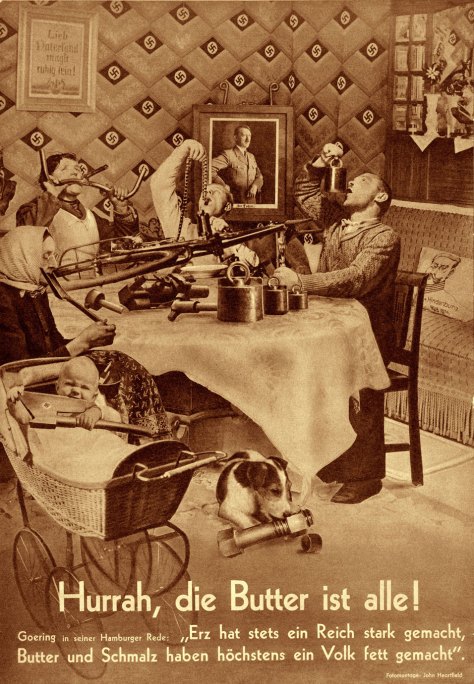
JOHN HEARTFIELD :: HURRAH DIE BUTTER IST ALLE, 1935

heartfield_hurrah-2John Heartfield (born Helmut Herzfeld; 19 June 1891 – 26 April 1968) was an artist and a pioneer in the use of art as a political weapon. Some of his photomontages were anti-Nazi and anti-fascist statements. Heartfield also created book jackets for authors such as Upton Sinclair, as well as stage sets for such noted playwrights as Bertolt Brecht and Erwin Piscator.

Continue reading JOHN HEARTFIELD :: HURRAH DIE BUTTER IST ALLE, 1935

PER KIRKEBY

Per Kirkeby (born 1 September 1938, in Copenhagen) is a Danish painter, poet, film maker and sculptor.  By the time he completed a masters education in arctic geology at the University of Copenhagen in 1964, he was already part of the important experimental art school “eks-skolen” and worked primarily as a painter, sculptor, writer and a lithographic artist which he has pursued ever since. Influenced by his scientific roots as well as the gestural works of the Abstract Expressionists, Kirkeby creates expressive, heavily layered paintings, which can resemble geological strata, the Danish landscape, and even the female form. Continue reading PER KIRKEBY

NICK CAVE :: SOUNDSUITS


Nick Cave (born 1959 in Fulton, Missouri, USA) is an American fabric sculptor, dancer, and performance artist. He is best known for his Soundsuits: wearable fabric sculptures that are bright, whimsical, and other-worldly. He also trained as a dancer with Alvin Ailey.

He resides in Chicago and is director of the graduate fashion program at School of the Art Institute of Chicago. Continue reading NICK CAVE :: SOUNDSUITS

VITO ACCONCI:: PRYINGS, 1971 17 min.

1971, 17:10 min, b&w, sound

A documentation of a live performance at New York University, Pryings is a graphic exploration of the physical and psychological dynamics of male/female interaction, a study in control, violation and resistance. The camera focuses tightly on Kathy Dillon’s face, as Acconci tries to pry open her closed eyes. Dillon resists, at times protecting her face or fighting to get away. Locked in a silent embrace, the couple’s struggle is violent, passionate; Acconci’s sadistic coercion is tinged with a sinister tenderness. The body is a vehicle for a literal enactment of the desire for and resistance against intimate contact.

Acconci writes, “The performer will not come to terms, she shuts herself off, inside the box (monitor), my attempt is to force her to face out, fit into the performer’s role, come out in the open.”

THE PAINTING TECHNIQUES OF FRANZ KLINE, AB EX NY, via MoMA 4 min

Aother great, short piece from the Ab Ex series, this one about Franz Kline’s materials a process. 4 min.  From the MoMA archives.

Filmed by Plowshares Media
Images courtesy of The Franz Kline Estate; Kate Rothko Prizel & Christopher Rothko; Artists Rights Society (ARS), New York; and The Museum of Modern Art, New York
Music by Chris Parrello
Chris Parrello, Ian Young, Kevin Thomas, Ziv Ravitz
© 2010 The Museum of Modern Art

DAVID SALLE: RECENT WORK , 2016

*A selected group of recent paintings (2016) from David Salle’s website.

MICHAELA EICHWALD

Born: Cologne, Germany, 1967

Lives and works: Berlin, Germany

“Michaela Eichwald’s alchemical paintings and sculpture are simultaneously hypnotizing and visceral—integrating the artist’s hand in a manner that is both base and instinctually human. Whether its pouring resin into paper bags or injecting cooked mussels and hair elastics, among other things, the difficulty in digesting these works is intentional. In her attempt to ignore art historical tropes, Eichwald’s work evokes Outsider art and disarms the audience’s desire for narrative. The romanticism of the German painting tradition, grounded by Dieter Roth and Gerhard Richter, also influences her output and links it to a figurative inclination. Linking object and image, Eichwald forces her audience to reconsider the facades of realism and artificiality.”-artspace.com/michaela-eichwald

Continue reading MICHAELA EICHWALD

JULIAN SCHNABEL: FOX FARM PAINTINGS, Pace Gallery, December 1989

27 years ago, in December 1989,  Julian Schnabel showed a new series of paintings at The Pace Gallery which was coined by critic Thomas McEvilley  as “The Fox Farm Paintings”. The paintings took a variety of shapes and forms but all were painted upon a deep, red velvet and incorporated the text: ”There is no place on this planet more horrible than a fox farm during pelting season.”

Below is a republished review of the show by Roberta Smith, for The New York Times:

Continue reading JULIAN SCHNABEL: FOX FARM PAINTINGS, Pace Gallery, December 1989