Immediately after Hurricane Katrina wreaked its havoc upon New Orleans, photographer Robert Polidori returned to the city he had inhabited long before, to bear photographic witness to its devastation for The New Yorker. He ended up staying much longer than he had originally planned, and returned many times to continue capturing images of the city’s abandoned desolation. One of the world’s premier architectural photographers, Polidori considered the wrecked rooms, collapsed houses, and ravaged neighborhoods on view in After the Flood as metaphors for human fragility. He navigated through the wrecked streets and collapsed, electricity-less, molding houses of the city toting his large-format camera. By virtue of long-exposures under natural light, Polidori produced hundreds of images.
“In each image, the artist seems to have captured the very air of New Orleans, weighted heavily with mold, humidity, and history.”-New Orleans after the Flood: Photographs by Robert Polidori, The Met, April 2006
“All artists, as best they can, make sense of a world that is often senseless. Mr. Polidori’s work, from Chernobyl to Havana — in sometimes dangerous, topsy-turvy, out-of-time places — generally bears witness to profound neglect. A photojournalist’s compulsion and problem is always to contrive beauty from misery, and it is only human to feel uneasy about admiring pictures like these from New Orleans, whose sumptuousness can be disorienting. But the works also express an archaeologist’s aspiration to document plain-spoken truth, and they are without most of the tricks of the trade that photographers exploit to turn victims into objects and pictures of pain into tributes to themselves.” -The New York Times, What’s Wrong With This Picture, Michael Kimmelman, Sept 22, 2006
“Robert Polidori is one of the world’s most acclaimed photographers of human habitats and environments. Creating meticulously detailed, large-format color film photographs, Polidori’s images record a visual citation of both past history and the present times within the confines of a single frame.
Born in Montreal, Polidori moved to the United States as a child. Polidori began his career in avant-garde film, assisting Jonas Mekas at the Anthology Film Archives in New York, an experience that critically shaped his approach to photography. While living in Paris in the early 1980s, he began documenting the restoration of Versailles, and has continued over a 30 year period to photograph the ongoing changes.
Polidori’s additional projects include Havana and the aftermath of the Chernobyl nuclear power plant meltdown. His current work deals with population and urban growth through photographing “dendritic” cities around the world, including Mumbai, Rio de Janeiro and Amman.” – Robert Polidori.com


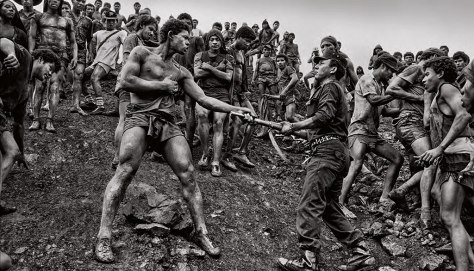 Sebastião Salgado is likely the most eminent photojournalist working today. Of Salgado’s many iconic images, perhaps the most famous is this picture of a dispute between Serra Pelada gold mine worker and military police taken in Brazil in 1986. It is the classic picture of tension with a twist–the authority is in the hands of the police on the right, but he earns much less than the miners thus infusing that facet of tension into the picture too.
 ‘The photograph that Elliott Erwitt made in 1953 of his newborn daughter and her mother in the family’s modest Manhattan apartment is among the most widely reproduced of its time, having appeared in venues as different as Edward Steichen’s seminal 1955 photography exhibition (and book) “Family of Man,” and in magazines, on postcards and even in drug company advertisements. But if Mother and Child is a mainstay of modern photography, to the mischievous Erwitt, 74, it’s just “a family picture of my first child, my first wife and my cat,” he says. “I still see it as a snapshot. But it happens to be a pretty good one.” -Adriana Leshko, Smithsonian Magazine, August 2002″

 “Dijkstra also finds rawness and vulnerability in people who are physically exhausted, such as mothers who have given birth, or matadors who have just left the bullfighting ring. Like the teenagers, their identity is in a precarious state, their exhaustion undermining their ability to pose. In this sense, these pictures are the converse of her photos of teenagers, which capture the making of identity. While the bloodied faces and jackets of the bullfighters remind us of the masculine violence and courage that defines their identity as bullfighters, their tired faces are softened and reveal their fragility as human beings. A similar series features the three naked mothers who have just given birth, and look fatigued and afraid. The hint of roundness in their bellies evokes the image of a saintly pregnant woman, and the way in which they clutch their babies to their chest is evidence of the maternal protective instinct. Yet they have just undergone a monumental change, from being pregnant to being a mother, and the photographs primarily confront us with their fear and exhaustion—rarely associated with the image of motherhood.” -Lauren Vanzandt-Escobar, Rineke Dijkstra’s Retrospective: Identity and the Expressive Fallacy, The American Reader,

 The Incubator