Aother great, short piece from the Ab Ex series, this one about Ad Reinhardt’s materials a process. 4 min. From the MoMA archives.

Aother great, short piece from the Ab Ex series, this one about Ad Reinhardt’s materials a process. 4 min. From the MoMA archives.
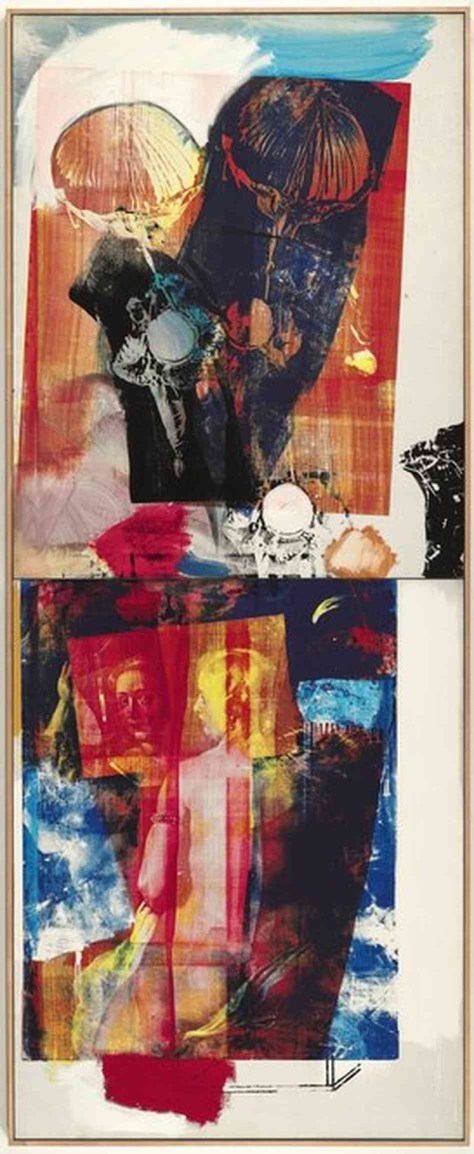 In the early 1960s, Robert Rauschenberg dedicated himself to a different kind of image-making, one that involved photographic transfer onto canvas. It was the birth of his celebrated series of Silkscreen Paintings which anticipated the post-modernist idea of appropriation, later one of the protagonist techniques of Pop art. What’s interesting is that in 1964, after he won the International Gran Premio for Painting at the Venice Biennale, the artist promptly phoned home to order that all of his remaining silkscreens be destroyed, to end the series.


27 years ago, in December 1989, Julian Schnabel showed a new series of paintings at The Pace Gallery which was coined by critic Thomas McEvilley as “The Fox Farm Paintings”. The paintings took a variety of shapes and forms but all were painted upon a deep, red velvet and incorporated the text: ”There is no place on this planet more horrible than a fox farm during pelting season.”
Below is a republished review of the show by Roberta Smith, for The New York Times:
Continue reading JULIAN SCHNABEL: FOX FARM PAINTINGS, Pace Gallery, December 1989
In this report for “Sunday Morning,” which originally aired on December 27, 1988, correspondent David Browning visited Diebenkorn’s studio in California’s Sonoma County, to discuss the artist’s “trial and error” approach; and New York’s Museum of Modern Art, where Diebenkorn was being celebrated by a one-man show of his drawings.
Corey D’Augustine (educator and independent conservator) discusses the techniques Mark Rothko used in the course of making his paintings.
filmed by Plowshares Media
Images courtesy of Kate Rothko Prizel & Christopher Rothko/Artists Rights Society (ARS), New York; and The Museum of Modern Art, New York
Music by Chris Parrello
Chris Parrello, Ian Young, Kevin Thomas, Ziv Ravitz
© 2010 The Museum of Modern Art


Palermo was born Peter Schwarze in Leipzig, Germany, in 1943, and adopted as an infant, with his twin brother, Michael, by foster parents named Heisterkamp. He adopted his outlandish name in 1964, during his studies with Bruno Goller and Joseph Beuys at the Kunstakademie Düsseldorf between 1962 and 1967. The name refers to Frank “Blinky” Palermo, an American Mafioso and boxing promoter who managed Sonny Liston. Continue reading BLINKY PALERMO


Morris Louis Bernstein was one of the earliest exponents of what became known as Color Field painting in the 1950s. While he was living in Washington D.C. he, along with Kenneth Noland, Gene Davis, Tom Downing, Howard Mehring Anne Truitt and Hilda Thorpe and others, formed an art movement that is known today as the Washington Color School. Ultimately Morris would become one of the leading figures of Color Field painting along with his peers Kenneth Noland and Helen Frankenthaler and Jules Olitski. Continue reading MORRIS LOUIS, Washington Color School Abstraction/Color Field Painting, Pt2
 The Incubator