
Philip Lorca-DiCorcia: Mary and Babe, 1982


“THE EROTIC, UNNERVING IMAGES OF HIGH HEELED SHOES WALKING, DISCONNECTED FROM THE BODY, ALONG BEACHES OR ACROSS INDUSTRIAL WASTELAND ARE IN CONTRAST TO OTHER SEXUALLY CHARGED PHOTOGRAPHS FOR FRENCH VOGUE”
– SUZY MENKES, VOGUE
Guy Bourdin, born in Paris in 1928, was the pioneering fashion photographer whose arresting photographs filled the pages of French Vogue for three decades from the 1950s through to the 80s. He is notorious for breaking the boundaries of traditional commercial photography and reshaping the classic fashion picture, using a daring narrative and vibrant colour palette. Vogue’s editor introduced Bourdin to the shoe designer Charles Jourdan, for whom he became the brand’s official advertising photographer, producing some of his best images during this period. The beauty in many of his pictures is that you can see small imperfections and fine details such as the models’ pores. In this respect they hold an integrity that is rarely seen today.
In 1950, Guy Bourdin met Man Ray and became his protégé. The spirit of the Surrealists is ever-present in Bourdin’s work: we see this in the dream-like quality of his pictures and the artist’s use of uncanny juxtapositions. Taking photography as his medium of choice, Bourdin explored the provocative and the sublime with a relentless perfectionism and sharp humour. He captured the imagination of a generation, and yet his images have a timeless quality, so much so that they continue to influence the worlds of fashion and advertising today, twenty years since his death.
To coincide with the UK’s largest ever exhibition of the influential and enigmatic fashion photographer Guy Bourdin at Somerset House, the Michael Hoppen Gallery is delighted to exhibit a wonderful group of images ‘Walking Legs’. Officially being unveiled alongside Somerset House’s show ‘Image-Maker’, ‘Walking Legs’, is one of Bourdin’s most loved Charles Jourdan campaign series. ‘Walking legs’ was shot in 1979 by the French designer and photographer using quintessentially English landscapes as the backdrop to this high-end campaign. Photographed at locations on a road trip taken in a Cadillac from London to Brighton, many of the city and seaside scenes remain the same today and include familiar sights such as the London bus stop and the classic park bench. As with much of Bourdin’s work, the model is mysteriously absent – all that is seen is a pair of mannequin legs, adorned with Charles Jourdan’s creations.
-Guy Bourdin, Walking Legs, Michael Hoppen Gallery, http://www.michaelhoppengallery.com/exhibitions/8/overview/#/image_standalone/14
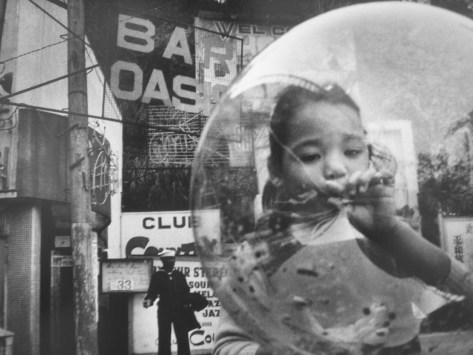 “Shomei Tomatsu (1930 – 2012) was perhaps the most influential Japanese photographer of the post-war era. His raw, grainy and impressionistic style signalled a dramatic break with the quiet formalism that had defined earlier photography. Influencing the anti-establishment Provoke photography movement in Japan in the late 1960s, he is hailed as the stylistic mentor of artists such as Daido Moriyama, Nobuyoshi Araki and Takuma Nakihara.”
-Michael Hoppen Gallery, http://www.michaelhoppengallery.com/artists/64-shomei-tomatsu/overview/#/artworks/9760


Raghu Rai was born in the small village of Jhhang, now part of Pakistan. He took up photography in 1965, and the following year joined “The Statesman” newspaper as its chief photographer. Impressed by an exhibit of his work in Paris in 1971, Henri Cartier-Bresson nominated Rai to join Magnum Photos in 1977. Continue reading RAGHU RAI, Magnum photojournalist


Immediately after Hurricane Katrina wreaked its havoc upon New Orleans, photographer Robert Polidori returned to the city he had inhabited long before, to bear photographic witness to its devastation for The New Yorker. He ended up staying much longer than he had originally planned, and returned many times to continue capturing images of the city’s abandoned desolation. One of the world’s premier architectural photographers, Polidori considered the wrecked rooms, collapsed houses, and ravaged neighborhoods on view in After the Flood as metaphors for human fragility. He navigated through the wrecked streets and collapsed, electricity-less, molding houses of the city toting his large-format camera. By virtue of long-exposures under natural light, Polidori produced hundreds of images.
“In each image, the artist seems to have captured the very air of New Orleans, weighted heavily with mold, humidity, and history.”-New Orleans after the Flood: Photographs by Robert Polidori, The Met, April 2006
“All artists, as best they can, make sense of a world that is often senseless. Mr. Polidori’s work, from Chernobyl to Havana — in sometimes dangerous, topsy-turvy, out-of-time places — generally bears witness to profound neglect. A photojournalist’s compulsion and problem is always to contrive beauty from misery, and it is only human to feel uneasy about admiring pictures like these from New Orleans, whose sumptuousness can be disorienting. But the works also express an archaeologist’s aspiration to document plain-spoken truth, and they are without most of the tricks of the trade that photographers exploit to turn victims into objects and pictures of pain into tributes to themselves.” -The New York Times, What’s Wrong With This Picture, Michael Kimmelman, Sept 22, 2006
“Robert Polidori is one of the world’s most acclaimed photographers of human habitats and environments. Creating meticulously detailed, large-format color film photographs, Polidori’s images record a visual citation of both past history and the present times within the confines of a single frame.
Born in Montreal, Polidori moved to the United States as a child. Polidori began his career in avant-garde film, assisting Jonas Mekas at the Anthology Film Archives in New York, an experience that critically shaped his approach to photography. While living in Paris in the early 1980s, he began documenting the restoration of Versailles, and has continued over a 30 year period to photograph the ongoing changes.
Polidori’s additional projects include Havana and the aftermath of the Chernobyl nuclear power plant meltdown. His current work deals with population and urban growth through photographing “dendritic” cities around the world, including Mumbai, Rio de Janeiro and Amman.” – Robert Polidori.com
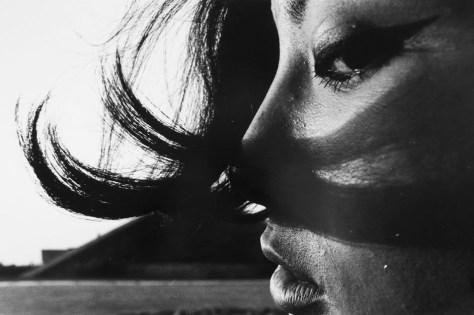 “Akira Sato, the Japanese photographer, was noted for his graphic and iconic experimental photographs of women. His seminal book, also entitled Woman, is an enigmatic collection of portraits finely meshed with a type of fashion, but as with all things Japanese, his work retained an exotic quality that was to define his style. Sato was born on July 30, 1930 in Tokyo. While a student of economics at Yokohama National University he was an avid reader of LIFE and other photographic and fashion magazines at the American CIE library in Hibiya. He graduated in 1953 and one year later made the move and became a freelance photographer, specializing in fashion. Continue reading AKIRA SATO :: UNTITLED, 1960
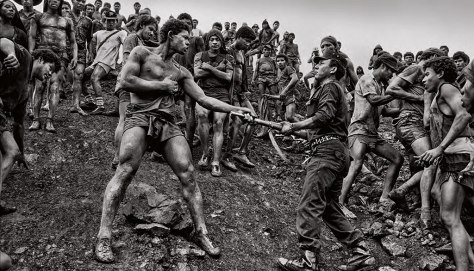 Sebastião Salgado is likely the most eminent photojournalist working today. Of Salgado’s many iconic images, perhaps the most famous is this picture of a dispute between Serra Pelada gold mine worker and military police taken in Brazil in 1986. It is the classic picture of tension with a twist–the authority is in the hands of the police on the right, but he earns much less than the miners thus infusing that facet of tension into the picture too.
“Serra Pelada was a large gold mine in Brazil 430 kilometres (270 mi) south of the mouth of the Amazon River. In 1979 a local child swimming on the banks of a local river found a 6 grams (0.21 oz) nugget of gold. Soon word leaked out and by the end of the week a gold rush had started. During the early 1980s, tens of thousands of prospectors flocked to the Serra Pelada site, which at its peak was said to be not only the largest open-air gold mine in the world, but also the most violent. Continue reading Sebastião Salgado :: The Hell of Serra Pelada
 ‘The photograph that Elliott Erwitt made in 1953 of his newborn daughter and her mother in the family’s modest Manhattan apartment is among the most widely reproduced of its time, having appeared in venues as different as Edward Steichen’s seminal 1955 photography exhibition (and book) “Family of Man,” and in magazines, on postcards and even in drug company advertisements. But if Mother and Child is a mainstay of modern photography, to the mischievous Erwitt, 74, it’s just “a family picture of my first child, my first wife and my cat,” he says. “I still see it as a snapshot. But it happens to be a pretty good one.” -Adriana Leshko, Smithsonian Magazine, August 2002″

 The Incubator